
The Viking helmet
Britain's first ever Viking helmet was discovered in Yarm.
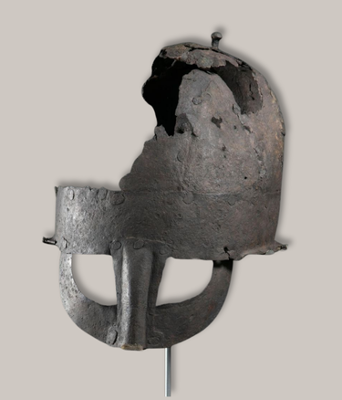
New research has shown that the corroded, damaged helmet that was unearthed in Yarm, Stockton-on-Tees, in the 1950s is a rare, 10th century Anglo-Scandinavian (Viking) helmet. This is the first of its kind ever found in Britain and only the second nearly complete Viking helmet found in the world.
In the 1950s, workmen digging trenches for new sewerage pipes in Chapel Yard, Yarm, made an unusual discovery - a battered helmet. The helmet, known locally as 'the Viking helmet', has been on loan to Preston Park Museum from Yarm Town Council for several decades.
It had never been researched before, and the helmet's age had caused much debate.
Research project
In recent years a project led by Dr Chris Caple, Emeritus Reader at Durham University, has been underway to discover new information about the helmet and the findings have been reported in the journal Medieval Archaeology 64/1.

The research process focused on:
- analysing the materials, shape and functional features of the helmet
- determining if the helmet is genuine
- how it was made
- how it had survived in the damp earth of the tidal riverbank of the River Tees
Yarm may not be where you would expect to find a Viking helmet. The only previous find of this date from Yarm was a piece of 9th century cross shaft, which is now in Durham Cathedral. Many pieces of Viking age sculpture belong to St. Martin's Church, Kirklevington, most of which are on loan to Preston Park Museum. This could indicate that Yarm was a Viking marketplace with merchants and leaders living in the Kirklevington area, 1.5 miles away. The helmet dates to before the establishment of the town and was found on the east side of the loop in the river, an area that could have been a quayside.
What was the helmet made from?
What was the helmet made from?

Samples from the helmet were analysed and shown to be made of an iron, typical of the early medieval period. There is no evidence that the helmet was decorated, while the minerals found in the helmet suggest that it was initially buried in waterlogged conditions. Was it deliberately hidden and then not retrieved because something happened to the owner?
Helmet features
Helmet features
The helmet's condition is so good that we can infer specific purposes in its design like characteristics such as:
- the hammer marks covering the surface and ragged edges of the infill plates show the helmet was made at a blacksmiths forge without benefit of additional refinement
- the rivet holes were punched through hot metal from the outer side, ensuring a smooth exterior that would not catch bladed weapons
- the out turned lip of the browband was a later alteration, pushing the mail curtain away from the neck, possibly to protect against an injury
- the circumference of the helmet is like that of other early medieval helmets and would have been worn over a padded cap around 16mm thick
- the metal is 1 to 2mm thick and would absorb the impact from a weapon

Who would have worn the helmet?
The construction of the helmet is of high quality and indicates that it was intended for use, not display. This fits with its suggested date of being Anglo-Scandinavian (Viking). By the 11th century, armies were larger and used tactics such as shield walls with archers raining arrows down, as shown in the Bayeux Tapestry. This differs from the individual combat of an earlier period where the use of armour would not have been necessary. The lack of armour, helmets and mail hauberks (shirt of chain mail) was considered a key factor in the Vikings losing the battle of Stamford Bridge in 1066.
The first Anglo-Scandinavian helmet to be found in Britain
The first Anglo-Scandinavian helmet to be found in Britain
Helmets were scarce throughout North-West Europe in the 6th to 8th century and only the richest male graves contained them. Highly decorated, they were a symbol of authority rather than protection. A number have survived because they were buried as grave goods. In the 9th to 11th century, the helmets were practical and undecorated but far more common, however, they rarely survived as they were recycled not buried as grave goods. The Yarm helmet now joins the Gjermundbu helmet, in Norway, as the second example from this period.
The iron from which the helmet is made, its method of manufacture, its shape, even its plain functional nature correspond well with a 10th century date. The spectacle mask suggests an object of Anglo-Scandinavian heritage. All the evidence points to this being a rare early medieval helmet which was most probably made and used in the north of England in the 10th century. The Yarm helmet was the first relatively complete Anglo-Scandinavian (Viking) helmet found in Britain and only the second discovered in north-west Europe. The Yarm Helmet can be seen in the museum.
This blog was adapted from Dr Chris Caple's report, 'The Yarm Helmet', Medieval Archaeology, 64/1, 2020. Images courtesy of Durham University.


