
Tippen Delta invalid car
This model is one of the earliest 'full-bodied' invalid three-wheelers.
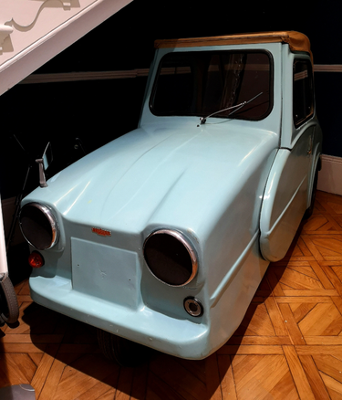

In the past, disabled people were seen driving alone in light blue, three-wheeled vehicles known as invalid cars. The cars were motorised trikes with a fibreglass shell. They were designed to carry a driver and a folded wheelchair only, other passengers were forbidden.
The cars were handed out in their thousands to some of the most vulnerable members of society by the government and the NHS until the 1970s. They were dangerously unstable and extremely loud.
Arrival of the NHS
After World War 2 there was a high demand for disability vehicles. The Ministry of Pensions provided these vehicles to injured ex-servicemen with mobility issues. The arrival of the NHS in 1948 saw the scheme extended to the wider disabled population.
The cars were leased from the government and were arranged through the hospital the owner attended.
Easy to use and reliable transport allowed owners to live independent lives. One local Teesside man said his life was transformed by a Tippen Delta as, it enabled him to work and attend social gatherings.
Making of the Tippen Delta
This model was built by Frank Tippen & Sons of Coventry and can be seen at Preston Park Museum. It is one of the earliest 'full-bodied' invalid three-wheelers and was the first to be painted the distinctive pale blue colour that gives the cars their recognisable appearance. It has a soft top, sliding door, a single wiper and a difficult to use 'tiller' steering and braking bar. There is a reverse switch behind the seat and an automatic transmission. Early models reached speeds of around 45 miles per hour (mph), although some say that in the right conditions it could reach up to 70mph.
Production of the Tippen Delta continued until the 1970s and was provided to users by the Invalid Carriage Service until it closed to new participants. The new Motability Scheme followed, offering disabled drivers a normal car with modified options. In 2003 they were banned from British roads altogether due to huge safety concerns. Thousands of cars in government warehouses were scrapped. Of the approximate 100,000 motorised vehicles produced in the UK from the 1920s onwards, only around 100 examples exist today.
This blog was written with help from Simon Mckeown and Stuart Cyphus of the Invalid Carriage Register.


